

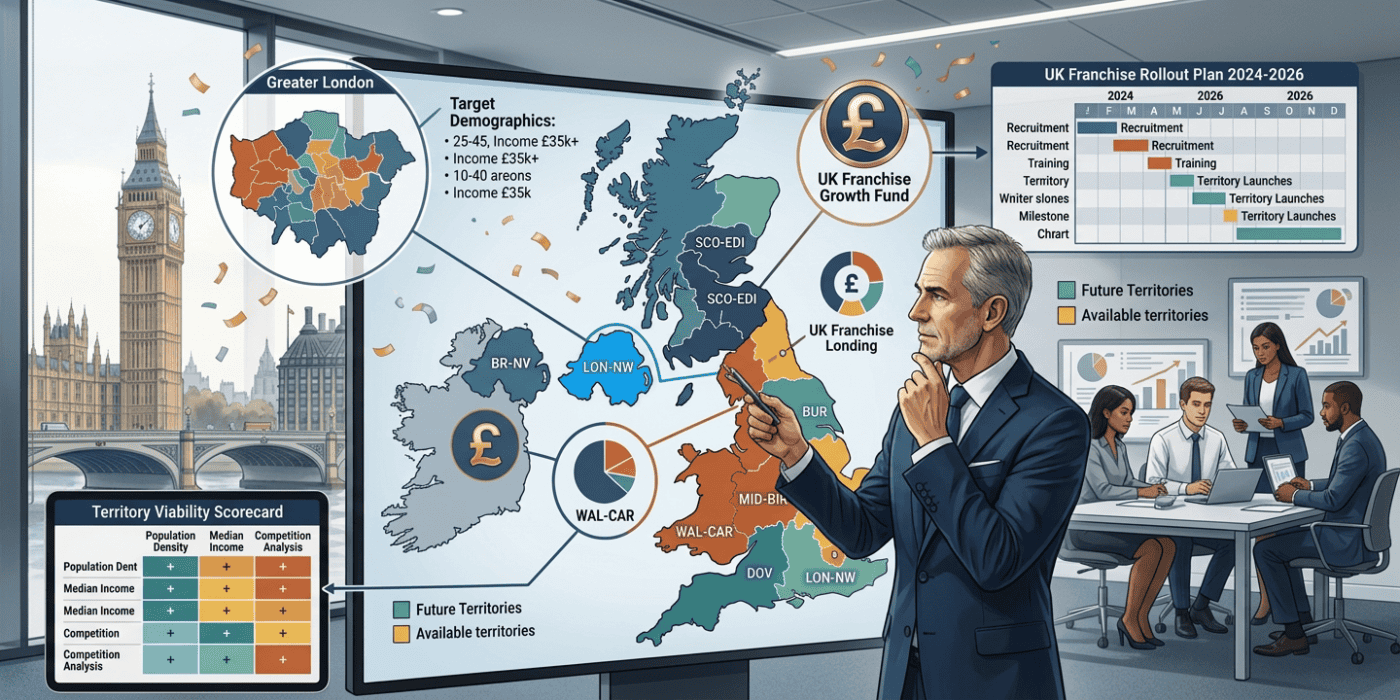
Dividing Up the UK Without Your Franchisees Competing
Picture the phone call. It’s a Tuesday morning, eighteen months after you sold your third franchise. One of your franchisees has found a job sheet from another franchisee, for a customer three streets from her house. She bought that postcode. She paid for it. And she wants to know what you are going to do about it.
Most franchisors never plan for that call. They plan for the first sale, which is understandable, because the first sale proves the model can grow. But territory decisions made quickly in year one tend to surface in year three, when the network has grown and the people inside it have started comparing notes.
This article covers how to divide up the UK so each franchisee has a fair, viable patch, your network can keep growing without people treading on each other, and that phone call never needs to happen.
Why territory planning is a franchisor decision, not a franchisee one
When a prospective franchisee asks which area they can have, the easy answer is “where do you live?” It feels helpful and it closes the conversation quickly. It is also how many networks end up with a map that looks like it was drawn one enquiry at a time, because it was.
The trouble shows up later. One franchisee gets a patch with twice the households of another for the same fee. A popular city gets carved up too finely, so nobody in it can reach the turnover in your projections. A large rural area gets sold as a single territory and sits half served for years, because one person cannot physically cover it and you cannot sell any of it to anyone else.
None of that is the franchisee’s fault. They took what they were offered. Territory is the part of your franchise system you design once and then live with, so it has to be designed before you start selling it.
What a good territory actually has to do
A territory is not just a shape on a map. It has three jobs, and a plan that only does one of them will cause problems.
It has to make a franchisee viable. The patch needs enough of the right customers to support the turnover in your franchisee projections after the management fee is paid. If your financial model assumes a franchisee needs a certain number of jobs a week, the territory must realistically contain the demand to produce them.
It has to be workable. A franchisee has to be able to serve it. For a mobile service business, that might mean drive time from one end to the other. For a site-based business, it might mean the catchment around a single unit. A territory that looks generous on paper but takes ninety minutes to cross is a burden, not a benefit.
It has to leave room for the network to grow. Your map needs to show where every future territory will sit, not just the next one. If you sell territories in the order enquiries arrive, without a whole-country plan underneath, you will be left with awkward pockets that are too small to sell and too remote for anyone to want.
The building blocks: how UK territories are usually defined
There is no single right method, but most UK franchisors build territories from a combination of the following.
Postcode districts. These are the most common building block because they are clear, easy to write into a franchise agreement, and understood by customers and franchisees alike. “You have LS21, LS29 and BD20” leaves very little room for argument.
Population or household counts. Postcodes on their own tell you nothing about size. Pairing them with population or household data lets you build territories of comparable value, so two franchisees paying the same fee get roughly the same opportunity.
Your target customer, not just headcount. This is the step most often skipped. A territory with plenty of people is not a strong territory if few of them buy what you sell. A children’s activity franchise cares about families with young children. A kitchen refurbishment business cares about homeowners. A B2B service cares about the number of businesses of the right size. Building territories around the people who actually buy from you produces a fairer map than raw population ever will.
Practical geography. Rivers, motorways, ring roads and rail lines often divide areas more naturally than administrative boundaries do. A territory that follows how people actually travel will be easier to run and easier to explain.
Exclusive, protected or open: decide what the line means
Drawing the line is half the job. The other half is deciding what the line promises, and writing that clearly into your franchise agreement.
An exclusive territory means no other franchisee, and usually not the franchisor either, can trade there. A protected territory typically means other franchisees cannot actively market there, though they may be able to accept a customer who contacts them directly. Some networks use a lighter model again, with a primary marketing area but no restriction on who serves whom.
Each of these is legitimate. What causes disputes is ambiguity. Before you sell a single territory, you need clear answers to questions like these:
- If a customer in one territory finds a different franchisee online and calls them, who gets the job?
- Who handles national or multi-site accounts that span several territories?
- How are enquiries from your central website routed?
- Can a neighbouring franchisee serve an unsold area in the meantime, and on what terms?
If you can answer each of those in a sentence, and the answer is the same every time, you have the start of a territory policy. If the honest answer is “it depends”, that Tuesday morning phone call is already on its way.
Getting the size right
Size is where franchisors feel the tension most sharply, and it is worth being honest about it. Larger territories are easier to sell. Prospects like them and they feel like better value. Smaller territories are easier to serve properly and leave more room to grow the network.
Make territories too large and you limit your own growth. You sell fewer franchises in total, parts of each territory go under-served, and that leaves the door open to competitors. Make them too small and your franchisees struggle to hit their numbers, and a struggling franchisee is rarely a quiet one.
The way through is to let your franchisee financial model set the size, rather than instinct or a prospect’s wishes. Work out what a franchisee needs to earn a good living after fees, work back to how many customers that takes, and then work out how many of your target customers a territory needs to contain to produce that reliably. The answer differs by sector, which is why we won’t quote a universal figure here. Anyone who gives you a single “right” population size without asking about your business is guessing.
Planning for the network you want, not the one you have
A good territory plan is a map of your finished network. It shows every territory you intend to sell across the UK, including the ones you won’t release for years.
That plan does three things for you. It helps you decide where to launch first, usually close to your base so you can support early franchisees properly. It stops you selling a territory now that blocks a better one later. And it gives prospects confidence, because they can see their patch fits into a deliberate plan rather than being cut out on the spot.
It is also worth building performance terms in from the start. If a franchisee consistently fails to serve their territory, your agreement should set out what happens next, whether that is agreed minimum performance levels, a reduction in area, or the right to appoint someone else. That is not about penalising anyone. It protects customers, the brand, and every other franchisee whose reputation depends on the network as a whole.
Even if you only have one franchisee in mind
Some business owners read this and decide it is a problem for later. They have one interested buyer and simply want to get them started.
That is exactly the moment to plan. The first territory you sell sets a precedent. Its size, its rights and its wording become the benchmark every future franchisee compares against, and they will ask. Changing the rules once people have bought in is far harder than setting them properly at the start.
How we approach territory planning at The Franchise Consultant
Territory mapping and design is part of the core franchise development work we do with every client, alongside your franchise model, fee structure and franchisee financial projections. We build these together on purpose, because a territory only makes sense when it is sized against the numbers a franchisee needs to hit. On our Rapid Launch Pro and White Glove Launch packages, this extends to advanced territory mapping and analysis.
The result is a UK-wide plan you can sell from with confidence, wording your franchise agreement can rely on, and a clear answer for every franchisee who asks why their patch looks the way it does.
If you are preparing to franchise, or you already franchise and your current map is starting to show strain, see how we work with franchisors from first assessment through to signed franchisees. Or call us on 0808 281 4727 to talk through your territory plan before your next area goes on sale.
Steve Lee is Managing Director of The Franchise Consultant, a bfa Advisor Member franchise consultancy. He is the author of Bought In, a guide to buying and building a franchise business.