

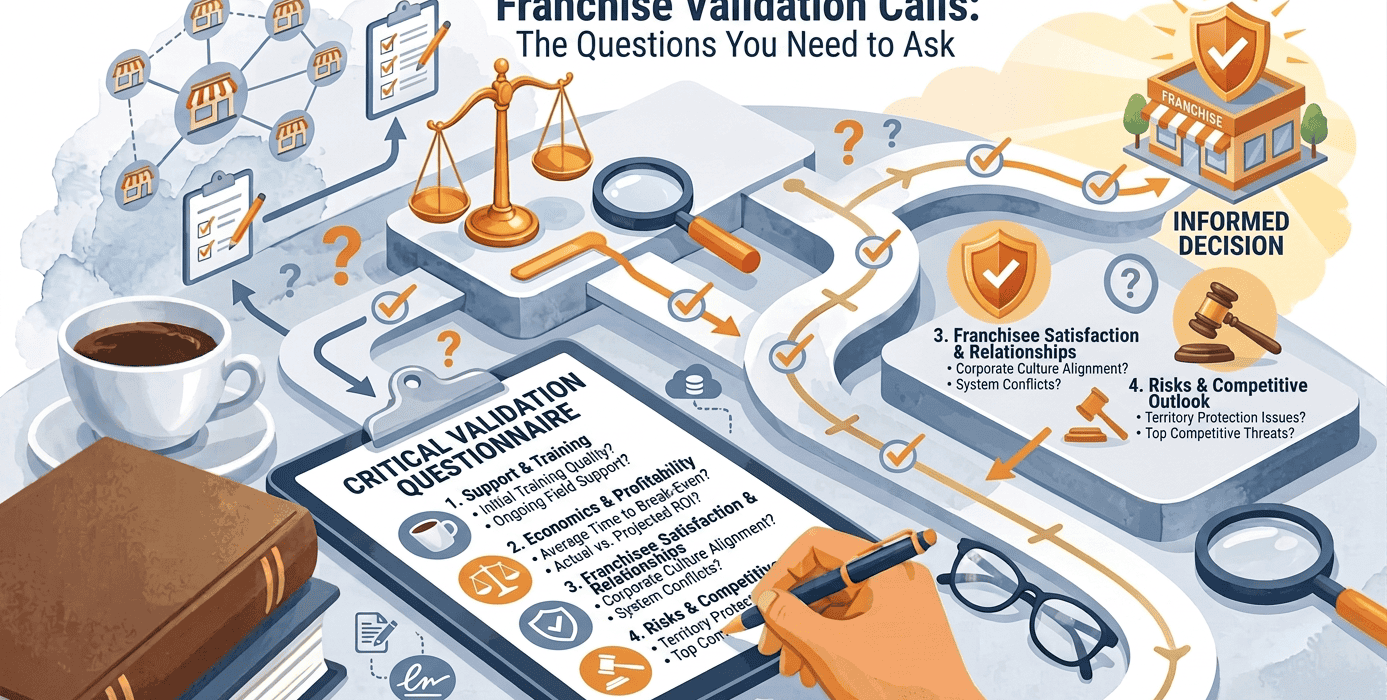
You have read the prospectus. You have sat through the discovery day. You have studied the Franchise Information Memorandum until the numbers blurred together. And now the franchisor says something like: “Here are the details of a few existing franchisees. Give them a call.”
This is the validation stage, and for most prospective franchisees it is the single most important part of the entire buying process. It is the one moment where you get to speak directly to people who are already living the reality you are about to invest in. Not the franchisor’s version of reality. Not the version written up in a glossy brochure. The actual, unfiltered, day-to-day experience of running that business.
And yet, most candidates treat these calls as a box-ticking exercise. They ask a handful of safe, polite questions, get the answers they expected, and move on feeling reassured without having learned anything that would actually change their decision.
That is a mistake. A costly one.
If you are about to put tens of thousands of pounds into a franchise, the validation call is not a courtesy. It is due diligence. And the questions that will protect you are not the ones most people think to ask.
What Is A Franchise Validation Call?
A validation call is a conversation between you and one or more existing franchisees in the network you are considering joining. The franchisor arranges it as part of their recruitment process, usually after you have reviewed the FIM and before you sign the franchise agreement.
The purpose, at least on paper, is straightforward. You get to hear from people who have already made the investment, gone through the training, and are now operating the business. They can tell you what works, what does not, and what they wish they had known before signing.
Franchisors offer these calls because they know that peer endorsement is the most persuasive thing a candidate can hear. A franchisor telling you the opportunity is strong is marketing. A franchisee telling you the same thing, unprompted, is proof.
But here is the part that rarely gets discussed openly. The franchisees you are given access to are almost always selected by the franchisor. That does not automatically mean the deck is stacked against you. Many franchisors are genuinely confident in their network and happy to let you speak to a range of operators. Some, however, will steer you towards their best performers and away from anyone who might raise concerns.
This is precisely why the questions you ask, and the way you ask them, matter so much. You are not there to confirm what you already believe. You are there to find out whether anything contradicts it.
Why Most Candidates Waste Their Validation Calls
There is a pattern we see again and again with prospective franchisees. They arrive at the validation stage already emotionally committed. They have pictured themselves running the business. They have told friends and family about it. Some have even started looking at premises or vans.
By the time they pick up the phone to speak to an existing franchisee, they are not really looking for information. They are looking for permission.
That mindset produces a very specific kind of conversation. The candidate asks broad, open questions like “How are you finding it?” or “Would you do it again?” The franchisee gives a broadly positive answer, because most people do not volunteer problems to a stranger unless prompted. The candidate hangs up feeling good, ticks the box, and moves on.
The problem is that none of those questions would have surfaced a territory overlap issue, or an undisclosed marketing levy, or the fact that head office takes six weeks to respond to support requests. Those are the things that matter when you are 18 months in and your cash flow is tighter than the projections suggested.
There are three common mistakes candidates make during validation calls.
The first is treating the call as a formality. If you go in assuming the answers will be positive, you will unconsciously steer the conversation away from anything uncomfortable. You will hear what you want to hear.
The second is being too polite. British reserve is real, and it costs people money. Asking a franchisee whether they are happy is not the same as asking them what their worst month looked like, or how long it took before they stopped subsidising the business from personal savings. You can be respectful and still be direct.
The third is not speaking to enough people. One franchisee is an anecdote. Three or four start to form a picture. If the franchisor only offers you one name, that itself is worth noting.
The Questions That Actually Matter
What follows is not a generic checklist. These are questions designed to get past the surface and into the detail that will either confirm your decision or save you from a bad one. They are grouped by theme, and each one is there for a reason.
Money and financial reality
This is where most candidates are too shy, and where the most important information lives.
How long did it take you to break even, and was that in line with what the franchisor told you to expect?
This question does two things at once. It gives you a real number to compare against the projections in the FIM. And it tells you whether the franchisor set realistic expectations or painted an optimistic picture to close the deal.
What were the costs that surprised you in the first twelve months?
Every franchise has costs that do not appear in the initial breakdown. Equipment replacements, software subscriptions, local marketing spend that the franchisor expects but does not explicitly require. This question surfaces those.
Are you earning what you expected to earn at this stage?
Notice the phrasing. You are not asking whether the business is profitable. You are asking whether the franchisee’s personal income matches what they were led to believe. Those are two very different things. A business can be technically profitable while the owner takes home less than they earned in their previous job.
Is the management fee good value for what you receive in return?
Franchisees pay a percentage of revenue to head office in exchange for brand support, marketing, systems and ongoing training. This question tells you whether that exchange feels fair to someone who is actually paying it.
Support from head office
The quality of franchisor support is the single biggest variable in whether a franchisee thrives or struggles. And it is the hardest thing to assess from a prospectus.
When you last had a problem, how quickly did head office respond, and did they actually solve it?
Speed of response and quality of response are not the same thing. You want both. A franchisor who replies within 24 hours but offers generic advice is not much better than one who takes a week.
How useful was the initial training, and was there anything you felt unprepared for when you started trading?
This tells you whether the training programme matches the operational reality. A two-week training course sounds thorough until you discover it did not cover the CRM system you will spend half your day using.
Has the level of support changed since you joined?
This is a subtle but telling question. Some franchisors invest heavily in new franchisees during the honeymoon period and then gradually withdraw. Others maintain consistent support across the life of the agreement. You want to know which you are buying into.
Territory and competition
Have you ever had a lead or a customer that should have been yours end up with another franchisee?
Territory disputes are one of the most common sources of frustration in franchise networks. The franchise agreement will define your territory on paper, but this question tells you how it works in practice.
Is your territory large enough to hit the revenue targets in the financial projections?
A territory that looks generous on a map can feel very different once you are working it. If the franchisee says their patch is tight, that is a data point you need.
Day-to-day lifestyle
What does a typical working week actually look like for you?
Franchise prospectuses tend to describe the business in its best light. This question gets you past the marketing and into the routine. How many hours? How much admin? How much time on the tools versus managing the business? Is there genuine flexibility, or is the “be your own boss” promise more of a talking point than a reality?
What is the one thing you would change about this franchise if you could?
This is the question most candidates never think to ask, and it is often the most revealing. It gives the franchisee permission to be critical without feeling disloyal. And the answer will tell you more about the franchise than twenty minutes of positive testimony.
The honesty questions
These are the questions that make franchisors nervous, because they cut through the narrative and get to the core.
Knowing what you know now, would you sign the agreement again?
Listen carefully to the answer. A quick, confident “yes” is a good sign. A pause followed by “yes, but…” is worth exploring. And anything that sounds like a qualified or reluctant answer is a signal you should not ignore.
Has anyone in the network left, and do you know why?
Franchisee turnover is not unusual, and it is not always a red flag. People leave for personal reasons, career changes and retirement. But if several franchisees have left within a short period, or if the reasons are consistently related to support, territory or profitability, that tells you something important.
Is there anything you feel the franchisor should have told you before you signed, but did not?
This is the question that makes the room go quiet. And that silence, if it comes, is information.
How To Read Between The Lines
Asking the right questions is only half of it. The other half is knowing how to interpret the answers.
Franchisees are human, and their responses will be shaped by loyalty, optimism, caution and the simple fact that most people do not enjoy being negative about something they have invested in. That does not mean they are being dishonest. It means you need to listen carefully.
Consistency is your strongest signal. If three franchisees independently describe the same frustration, whether that is slow support response times, rising marketing levies or a territory that feels too small, you are looking at a structural issue, not one person’s bad experience.
Pauses matter. When you ask a franchisee whether they would sign again and there is a noticeable hesitation before the answer, that pause is telling you something the words that follow may not. People who are genuinely satisfied do not need to think about it.
Watch for scripted language. If a franchisee’s answers sound rehearsed, or if they use the same phrasing that appeared in the prospectus, they may have been briefed by the franchisor on what to say. That does not necessarily mean the franchise is bad. But it does mean you should seek out additional franchisees to speak to, ideally ones you have found yourself rather than ones hand-picked by head office.
Pay attention to what is not said. If you ask about support and the franchisee talks at length about how much they enjoy the work but says nothing about the support itself, that omission is deliberate. People avoid topics they do not want to be negative about.
Finally, notice the difference between enthusiasm and contentment. A franchisee who calmly and factually explains that the business is meeting their expectations and they are on track financially is giving you more useful information than one who gushes about how “amazing” the opportunity is. Calm confidence is a better indicator than excitement.
When The Right Questions Change The Outcome
Consider a scenario we see more often than you might expect.
A candidate, let us call her Sarah, was in the final stages of buying into a home services franchise. The FIM looked solid. The discovery day had gone well. The franchisor was professional and responsive. Everything pointed towards signing.
Sarah was given three franchisees to speak to. The first two calls were positive but brief. Both franchisees said they were happy, the training was good, and they would recommend the brand. Sarah almost stopped there.
But she made a third call, and this time she asked different questions. Instead of “How is it going?” she asked: “What did your first six months actually look like, week by week?” The franchisee described a much slower start than the projections had suggested. It had taken nearly nine months to reach a consistent level of bookings, not the four to five months outlined in the FIM.
Sarah then asked: “Were the marketing costs in the first year what you expected?” The franchisee explained that on top of the national marketing levy, there was a strong expectation from head office to run local campaigns at the franchisee’s own expense. That cost had not been clearly set out in the initial documentation. It added several thousand pounds to the first-year outlay.
Sarah did not walk away from the opportunity. But she went back to the franchisor with specific, informed questions about cash flow in the early months and the true cost of local marketing. She negotiated a small adjustment to her payment schedule during the ramp-up period and budgeted for the additional marketing spend from day one.
She signed, launched successfully, and later said that the third validation call was the most useful conversation she had during the entire process. Not because it raised a dealbreaker, but because it gave her the information she needed to plan properly.
That is what a well-conducted validation call does. It does not necessarily talk you out of the franchise. More often, it prepares you for it.
What To Do With What You Learn
After two or three validation calls, you will probably have a mix of responses. Some positive, some cautious, and perhaps one or two things that gave you pause. That is normal. No franchise is perfect, and hearing a range of experiences is not a reason to panic.
The question is how to weigh what you have heard.
Start by separating structural issues from personal ones. A franchisee who says they struggled because they did not follow the system is telling you something about themselves, not about the franchise. A franchisee who says they followed the system but still struggled in the first year because the territory was too small is telling you something about the model.
Look for themes, not outliers. One person’s bad experience may be exactly that. But if three separate franchisees all mention the same gap in training, the same delay in support, or the same unexpected cost, that is a pattern and it needs to be addressed before you commit.
Use your findings as leverage, not as reasons to retreat. If validation calls surface a concern, raise it directly with the franchisor. A good franchisor will acknowledge it, explain the context, and show you what they are doing about it. A franchisor who dismisses your concerns or becomes defensive is giving you one last piece of important information.
And if you are struggling to get honest answers from the franchisees the franchisor provided, consider doing your own research. Company records at Companies House can tell you how many franchisee entities have been registered and dissolved. Online reviews and social media can offer an unfiltered view. And if you can identify franchisees who were not on the approved list, their perspective may be the most valuable of all.
The Bottom Line
Validation calls are not a courtesy extended by the franchisor. They are your opportunity to test the claims made in the prospectus, the FIM and the discovery day against the lived experience of the people who are already in the network.
The questions listed above are not designed to catch anyone out. They are designed to give you the clearest possible picture of what you are buying into, so that when you do sign, you sign with confidence rather than hope.
If you are earlier in the process and still weighing up whether a particular franchise is worth pursuing, we have also written a separate guide on the general due-diligence questions you should be asking the franchisor directly: Twelve Questions to Ask Before You Buy a Franchise (So You Don’t Regret It).
And if you want to see how thorough due diligence plays out in practice, take a look at our case studies to see how businesses across a range of sectors have built successful franchise networks with the right preparation and support.
The best franchise decisions are informed ones. The validation call is where that information lives. Use it properly.
Steve Lee is Managing Director of The Franchise Consultant, a bfa Advisor Member franchise consultancy. He is the author of Bought In, a guide to buying and building a franchise business.